What are the different types of skiing?
If you are new to skiing you might be wondering about the different types of skiing and skis that they talk about. It can be quite confusing, especially if you are considering buying some skis. Here is a brief overview of the different types of skiing and what gear is used.
Downhill/Alpine skiing
Skiing at ski resorts on groomed runs/pistes using chairlifts and other mechanical devices to take one to the top of the pistes. The skis and bindings are designed for downhill and the boots are stiff and fixed to the skis by the bindings. Poles are usually used also. Advanced skiers may go off-piste but they must go in a downhill direction.
Backcountry/Off-piste skiing
Any skiing away from the groomed runs by people who enjoy exploring places away from the crowds, and who enjoy the added exercise, as well as the challenge that off-piste skiing can offer. Off-piste skiing can be done with downhill gear if it is in a generally downhill direction or with specialised backcountry touring gear that allows one to go uphill unassisted. Typically, backcountry skiing is done with backcountry skiis, bindings, backcountry poles and skins that are applied to the underside of the skis to permit skiing uphill. The heel of the boot is not fixed to the ski as in downhill/alpine skiing. It is advisable to always go with someone skilled in mountain safety and avalanche risk assessment as well as carrying safety equipment.
Cross Countryskiing/Nordic skiing
This is a style of self-propelled skiing that has two styles; the first, classic style, uses a very natural walking/running style to glide along undulating terrain; the second is skating that uses shorter skis and the legs move out to the sides to propel one along in a skating action. Skate style cross country requires groomed runs but neither cross country style is appropriate for the steep slopes of downhill or alpine skiing.
Alpine Touring/Randonnee
This is a type of backcountry that doesn´t use the ski centre chairlifts and is generally practised well away from the ski centres. The ski bindings allow the heel to lift freely to allow uphill movement, for the descent the heel of the ski boot is locked in so one can ski down much like downhill skiing. The gear used and skills required are similar to backcountry ski requirements.
Telemark skiing
Back in the 1980´s I remember my stepfather practising the art of telemark turns on a downhihll slope, heel unfixed with the distinctive forward leg lunge that for me was impossible to imitate and led to many faceplants in the snow. It is, perhaps, a dying art or style, being overtaken by new randonee gear designs that are far more practical and efficient. The boots and bindings required are specific to telemarking but the skis, skins and poles can be any that are for backcountry skiing.
Ski Mountaineering
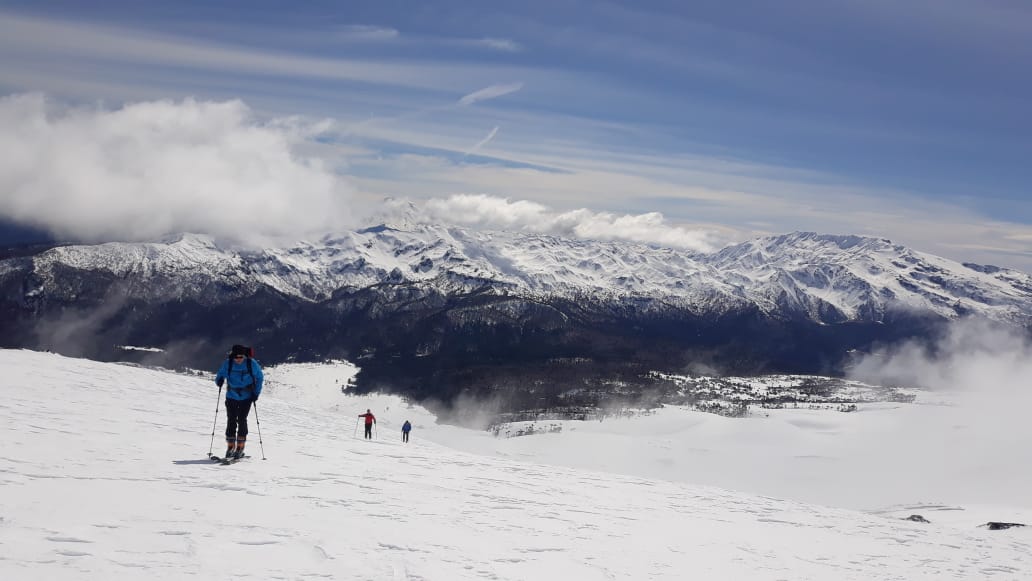
This is also another kind of backcountry skiing that focuses on scaling mountains, combining classic mountaineering skills with skiing. Quite a lot of gear and skill is required for this, and local experienced guides are often used. The Andes mountains of Chile/Argentina are the perfect place for this activity. There is no shortage of volcanoes to climb. Volcán Antuco, Lonquimay, Llaima, Villarica, Antuco and Cerro Castillo are just a some of the summits climbed. Backcountry skis, skins and poles are normally used, along with safety equipment such as crampons, ice axe, helmet, probe & Arvas or search beacons.
Freestyle skiing
This is a popular competative ski sport involving jumps over specifically designed moguls, acrobatic spins and turns. The gear used are downhill skis (or snowboard), downhill boots, bindings and poles.
Adaptive skiing
Many well developed ski centres now cater in some way for skiiers with physical disabilities. Adaptive skiing is the name for skiing by people with a physical disability or confined to wheelchair. In Chile there are organisations and ski centres that offer services for people with physical disabilities. However, for the smaller centres such as Los Nevados de Chillan and Corralco it is advisable to enquire prior to booking.
Photo: thanks to mountain guide Pep Sanper. Ski mountaineering, Volcano Llaima, Chile