
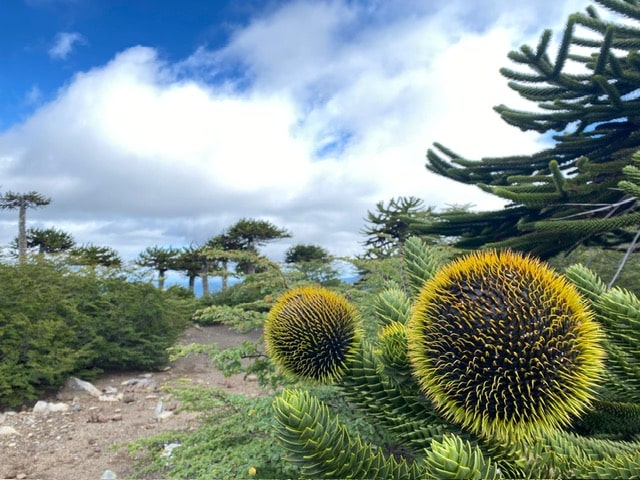
The jewel of the Araucanía Andina
The ancient indigenous Mapuche culture together with the iconic national emblem, the Monkey Puzzle tree, (Araucaría araucana), make the Araucanía Andina an area very special and well worth a visit on on your way to or from Patagonia.
The Araucanía Andina zone in the central-south of Chile is the area of the Andes mountain range where these giant gymnosperms can be found. Emerging from the Jurassic and Triassic periods there is evidence of their existence 60 to 200 million years ago when they would have inhabited the earth at the time as the dinosaurs. In that era it is quite possible that it covered a large part of the earth but now it has been reduced to the high peaks of the Andes in the central-south of Chile and Argentina and a small patch on the Chilean coastal mountain range Nahuelbuta. Although they can live for 1000 years or more, this forest type is in decline, now occupying just 392 km2 (4.219e+9 square feet). The Monky Puzzle Tree has been declared endangered by the International Union for Conservation and Nature (IUCN). The threats to the species survival include over-harvesting for timber (and seeds), grazing, clearing and wildfire.
From within these temperate Nothofagus (Beech) forests where the Monkey Puzzle tree dominates, majestic, active volcanoes arise, adding to the ancient feel of the landscape. The walks are, therefore, very scenic with no shortage of photo opportunities.
One of the most enjoyable aspects of exploring this area is the lack of crowds when compared to better known locations such as Torres del Paine or Pucon. Conguillío National Park is gaining in popularity and some of the walks do attract a lot of people but there are many other tracks within and outside Conguillío National Park where you see few or no people. Fortunately, CONAF has a daily limit on entrance tickets, therefore, it´s best to anticipate your visit and book online, although it is possible to buy your ticket at the gate, provided they haven´t reached the entrance limit.
There are private conservation parks for the Araucaria araucana in and around Malalcahuello. One of these that facilitates access for their clients is: https://www.chilewild.com/reserva-biosphera-las-araucarias
They have 120 hectares (297 ac.) of Monkey Puzzle- Beech forest for conservation where one can walk and even enter Conguillío National Park along the Sierra Nevada ridgeline that leads to the summit. Sierra Nevada is the base of a volcano eroded that in its time was the largest in the region.
These parks and volcanoes form part of the Kütralkura Geopark of UNESCO (The United Nations Organisation for the Education, Science and Culture). The name of this park comes from the Mapuche language that means “stone and fire”, a reference to the volcanism of the region.
How to arrive
Malalcahuello is a great place to visit as it is surrounded by the Araucaria araucana forest. From there one can access Conguillío National Park, the National Reserve Malalchuallo-Nalcas and the China Muerta National Park. Malalcahuello is a rural town that is transforming into a tourist centre for skiing and mountain/nature-based activities. One can find all types of accommodation and there are many options for different activities.
By car
Approaching from within Chile, one leaves the highway 5 (the main highway connecting the north and south of Chile) at the Victoria exit (if coming from the north), some 620 kilometres (383 mi.) from Santiago. If coming from the south, take the Lautaro exit (some 30 km/31 mi. from Temuco). Curacautín is aproximately 1 hour from Victoria and a little more from Lautaro. Malalcahuelllo is another 2o minutes or half an hour from Curacautín.
If coming from Argentina, you can cross the frontier at one of two passes: Pino Hachado or Ilcalma. Neuquen is the closest Argentinian city to these passes.
By bus
There are direct buses from Santiago to the towns of Curacautín, Malalcahuello and Lonquimay. Turbus and Jetsur leave quite late at night and arrive between 6am and 8am the next morning. They have options of recliner seats or bed seats. Buses coming from Neuquen and Bariloche also travel past Malalcahuello and Curacautín on their way to Temuco.
By plane
Flights from Santiago arrive to Temuco, with leaving at various hours during the day. From the airport Araucanía there are transfer services to Temuco and rental car services.
Where to stay
There are many accommodation options in and around Malalcahuello, Curacautín, Lonquimay and Melipueco. For quality cabins with services such as spa, sauna and fresh farm products from our fresh goat milk, click here to book Chile Wild cabins.


